Measuring GEO Results
Two free-tier tools — Mangools AI Search Grader and HubSpot AI Grader — let you quantify brand visibility inside ChatGPT answers. Here is what each measures, and their real limitations.
What you'll learn
- Understand what Mangools AI Search Grader and HubSpot AI Grader each measure
- Know the practical limitations of both tools (commercial-only, prompt variability)
- Learn how to build a monthly GEO reporting format
- Apply these tools without over-interpreting a single test run
Mangools AI Search Grader
Enter a brand and a niche/service description; the tool generates 10 prompts and reports averaged metrics: Visibility (how often the brand appears), AI Search Score (a combined visibility + position score), Average Position, and Rank among Top-10. Testing shows results can shift by roughly ±20% between runs of the same query — always average across multiple runs rather than trusting a single test.
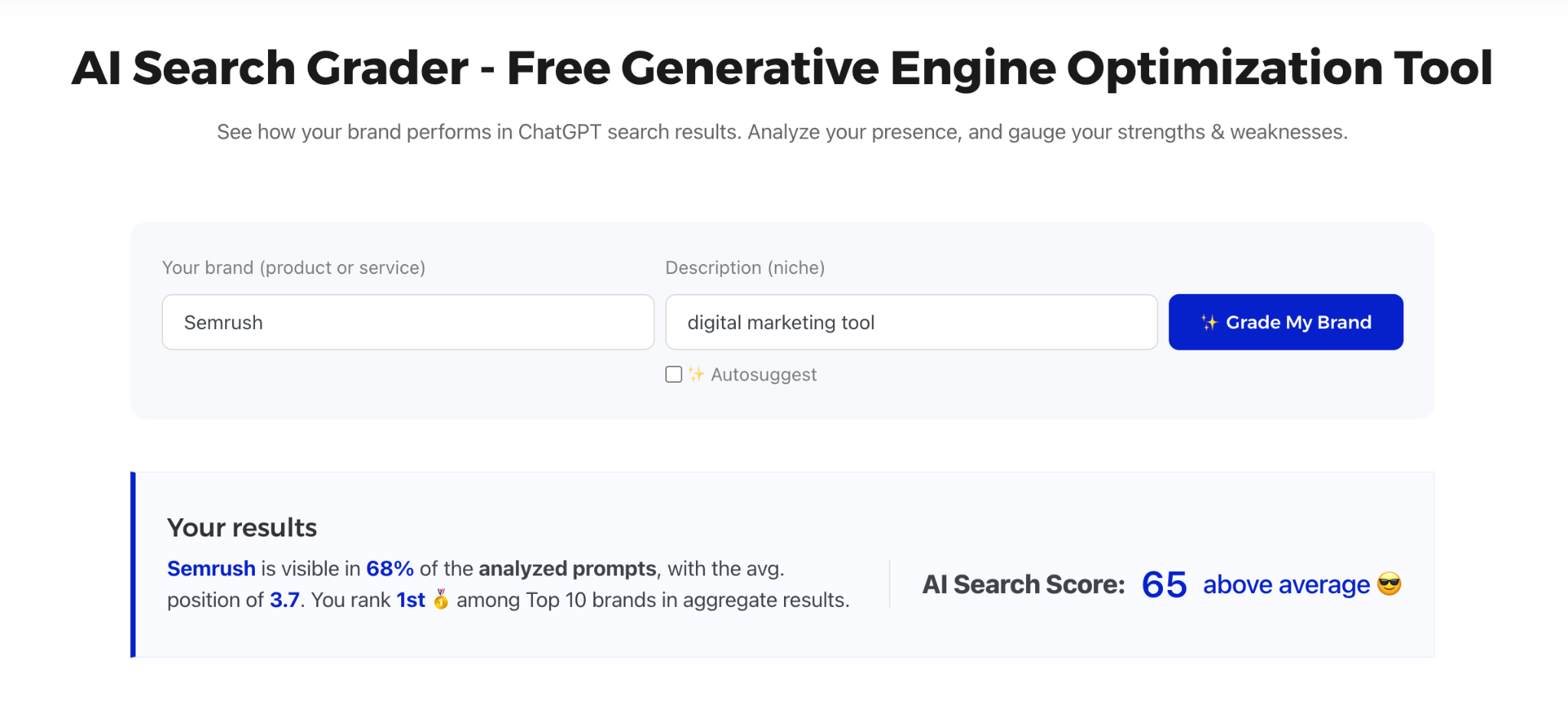
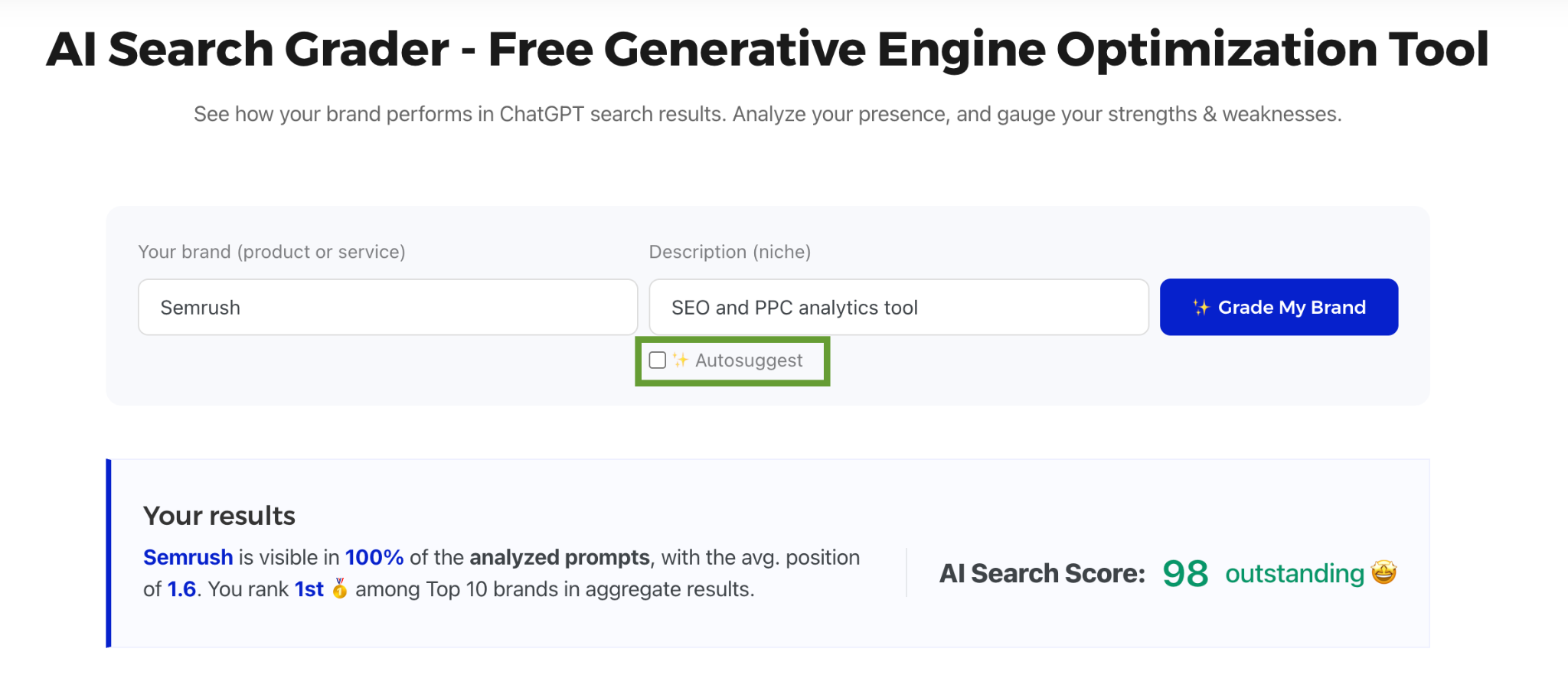
The tool cannot evaluate visibility for purely informational queries — its generated prompts always anchor tightly to the brand's core commercial service, even when you input an unrelated keyword. Never enter a URL in the brand field; it silently returns no data. Autosuggest, which guesses the niche automatically, gets it wrong often enough to require a manual check — one real test had it label a car-finance brand as a "car rental service."
Don't Treat the Score as Ground Truth
Real testing surfaced a case worth internalizing: for the query "top-rated digital marketing tools for content marketing," Mangools ranked HubSpot #1 — but the same prompt typed directly into ChatGPT put Grammarly in the #1 spot, a brand Mangools didn't surface at all, while HubSpot landed around #12 in ChatGPT's actual answer. For a narrower query ("best affordable digital marketing tools for startups"), Mangools scored the test brand at position 7, while the brand didn't appear in ChatGPT's real answer at all, across several repeated tries in fresh chats. The lesson: Mangools' score is a useful trend indicator, not a substitute for actually reading what the AI says — always spot-check the tool's output against a real ChatGPT query before reporting a number to a client.
HubSpot AI Search Grader
Takes Company Name, Location, Product/Service, and Industry, and returns three headline metrics: Total Score, Brand Sentiment, and Share of Voice, plus a competitor visibility breakdown and a list of AI-perceived pros/cons for the brand. The exact prompt set behind these scores isn't disclosed, but results are broadly consistent with Mangools — suggesting similar underlying methodology.
Choosing Between Them
| Need | Best tool |
|---|---|
| Track commercial keyword visibility over time | Mangools AI Search Grader |
| Understand brand sentiment / perceived strengths and weaknesses | HubSpot AI Grader |
| Identify direct competitors in AI answers | Either — HubSpot's Share of Voice report is slightly more built for this |
Building the Monthly Report
Track the same prompt set every month (averaging multiple runs), log both tools' scores side by side, and pair the data with manual ChatGPT/Perplexity checks with screenshots for the client-facing evidence — automated scores alone aren't enough proof for a client deliverable; screenshots close the credibility gap.
Key Takeaways
- Mangools AI Search Grader measures Visibility, AI Search Score, Average Position, and Top-10 rank for commercial queries
- HubSpot AI Grader measures Total Score, Brand Sentiment, and Share of Voice with competitor breakdown
- Neither tool reliably measures informational-query visibility — both anchor to commercial service description
- Results can vary ±20% between runs of the same query — always average multiple runs, never trust one test
- A tool's ranking can disagree sharply with what ChatGPT actually says (different #1 brand, brands missing entirely) — always spot-check against a real AI query before reporting a score
- Pair automated scores with manual ChatGPT/Perplexity screenshots for credible client-facing reporting